It is cool this morning. With still somewhat stiff limbs, the guests of the Pumba Private Game Reserve - a private nature park in South Africa's Eastern Cape region - take their seats in the safari vehicle. A fresh breeze makes most travellers quickly slip into the warming ponchos that are at the ready.
Experience in the Eastern Cape: Sunrise Safari
Ranger Brandon Pienaar steers his heavy twelve-seater over hair-raising moguls and can still spot traces of antelopes, hyenas and giraffes even in the dust-dry sand. Elephants, rhinos and even two cheetahs are spotted in the distance.
The rising sun bathes the hilly landscape in a magical light. Nevertheless, the 23-year-old ranger seems dissatisfied. The animals he is determined to track down today in the 7,000-hectare game reserve seem to have disappeared off the face of the earth.
At this point you will find external content from Qualtrics Ireland Limited that complements the article. You can view it with one click.
In fact, they are a rarity in the animal kingdom. Locals attributed divine powers to them. Even though skins of them appeared from time to time and travellers claim to have seen them for the first time in 1938, they remained a phantom, a legend, until the mid-1960s: white lions.
White lions: the fear of poachers is great
It was not until 1975 that a US biologist observed a pride in the Timbavati area south of the Kruger National Park. A sensation at the time. After that, a merciless hunt began for the few white lions with their blue eyes - which, by the way, are not albinos, because they have red eyes.
In 1996, when the madness was stopped, there were only about 20 white lions left in the world. Today, there are around 600 again. "The Pumba Private Game Reserve has its share in this," Brandon Pienaar explains to us. Since 2006, the fascinating big cats with their genetically mutated fur colour have found a new home here. However, the ranger is silent about the exact number of lions and rhinos in the park. The fear of tempting poachers is too great throughout South Africa.
Suddenly Pienaar slams on the brakes and stops the car. He listens, everyone is silent and eavesdrops. And sure enough, a roar can be heard from somewhere in the undergrowth. Carefully, the ranger turns into a narrow bush track.
And after a few metres, there he is: a mighty white lion straight out of a picture book. He looks at the visitors and they at him. A moment you will never forget.

At twelve years old, Timba the white lion is the "old boy" in the Pumba Private Game Reserve.
"This is Timba, our old boy," says Brandon Pienaar. "Lions in the wild live to a maximum of 15 years, and Timba is already twelve," the ranger explains further. "We are proud of Timba because he is a handsome animal." The lion has two sons.
One has taken over his pride. The other hunts along for the old animal, leaving him scraps of the antelopes or warthogs he has killed. This is quite unusual among the big cats, remarks Pienaar, who after a few minutes finally lets the car roll carefully back onto the main path - full of pride at having shown his guests this wonder of nature.
In any case, the people here in the Eastern Cape, whose most famous city is Port Elizabeth, are considered particularly proud. Also because the Eastern Cape region is perhaps the most authentic part of South Africa. In contrast to the dazzling Western Cape with Cape Town as its metropolis, the wine estates around Stellenbosch or the Garden Route, the Eastern Cape is rougher but more complex.
It is the traditional tribal area of the Xhosa, whose click sound language made the unforgettable singer Miriam Makeba famous. With Nelson Mandela, Walter Sisulu, Steve Biko, Oliver Tambo or Thabo Mbeki, the most famous anti-apartheid leaders also come from the hilly region, which is about half the size of Germany.
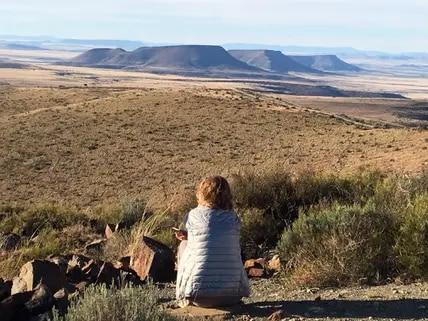
Time to relax: View of the vastness of the Karoo - here in Camdeboo National Park.
Here, the British and Boers fought bloody border wars with the advancing Xhosa, which only ended in 1878 - after a hundred years of fighting. Nevertheless, the region remained sparsely populated, and large parts of nature are still almost untouched.
Addo Elephant Park is home to the Big Seven
The best-known national park is the Addo Elephant Park near Port Elizabeth. Because parts of the park extend to the ocean, it can boast of being home to the Big Seven - i.e. apart from elephant, lion, rhino, leopard and buffalo, it is also home to the southern right whale and white shark.
There is also the Mountain Zebra and Camdeboo National Parks, as well as some Private Game Reserves like the Pumba. Best of all, all are malaria-free.
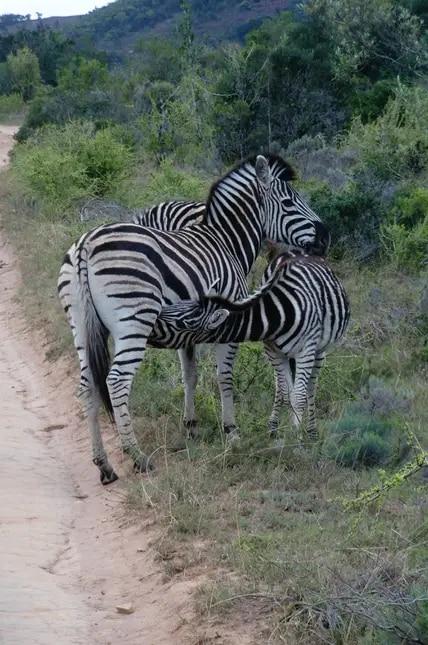
Zebras are among the many animals that travellers can observe in the Eastern Cape.
And then there is the mysterious Karoo: South Africa's largest semi-desert, which dominates large parts of the Eastern Cape. Gentle grassy hills, endless plains, mountains up to 1,500 metres high and bizarre rock formations like in the Valley of Desolation near the Victorian-looking town of Graaff-Reinet - incidentally the fourth oldest in South Africa - characterise its landscape.
Hester Styneberg, who runs the cosy Ganora Guest Farm together with her husband on a 1,300-metre plateau in the Karoo and lives mainly from merino sheep farming, would never move away from here. "The Karoo and the Eastern Cape are the real South Africa," she also says proudly.
"Not only Boers and British, Xhosa or Zulu have shaped the history of the country, the Khoikhoi and San were here before them," Styneberg tells us.
Dubbed Hottentots or Bushmen by the white immigrants, they are now equal members of the Rainbow Nation. One of them is the Khoisan Henry, who works on the Ganora farm and knows the Karoo like the back of his hand.
When he walks across the savannah with visitors, they can't keep their mouths shut with amazement: Henry knows exactly which inconspicuous succulents give water, which scrawny herb helps against colds or arthritis and which root curbs the appetite or increases the libido.
And then he leads the visitors under a ledge of a huge rock terrace, which glows in the evening sun in all the shades of brown that the colour palette seems to offer. Henry points to a few drawings. "These are from my ancestors, painted from a mixture of animal blood and charcoal."
And indeed, you recognise the images of people hunting wildebeest, zebra and antelope with bows and arrows. "These prehistoric works of art are around 7,000 years old," Henry explains to his listeners. And once again, they can't help but be amazed and seem to succumb to the magic of the Karoo, the hinterland of the mysterious and breathtaking Eastern Cape.
Tips for your trip to South Africa
How to get there: South African Airways flies daily non-stop from Frankfurt am Main and Munich to Johannesburg in 10.5 hours, then on to Port Elizabeth in 1.5 hours.
Best time to visit: From April to October, the Eastern Cape region enjoys stable, summer-like weather conditions. Between May and September it can get cooler. Warm clothing should then be remembered for morning safaris.
Accommodation: The Pumba Private Game Reserve and Spa is a luxury five-star hotel near Port Elizabeth. Ganora Guest Farm offers three-star cottages on a sheep farm near Nieu-Bethesda. The Drostdy Hotel in Graaff-Reinet (five stars) offers 48 very individual rooms.
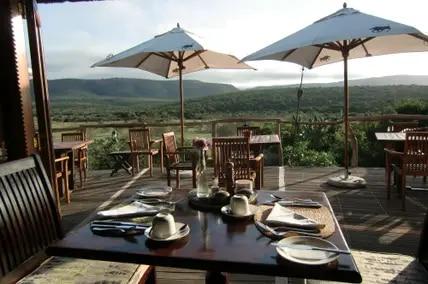
From the lodge's breakfast terrace in the Pumba Private Game Reserve, guests have everything in view.
Currency: The official currency is the rand. At the current exchange rate, travellers get 15 to 17 rand for one euro. Money should only be exchanged at the airport on arrival, Visa and Mastercard are accepted.
Related articles

Safari in South Africa: The most beautiful parks for the Big 5

West Coast South Africa: My Tips & Highlights

South Africa Travel Tips: Experiences, Route, Tips

Kruger National Park, South Africa: where it is, when to go and what to see

Top luxury resorts in South Africa

What to Know for a Trip to South Africa

Safari in Africa: The best parks

Travel Ideas | The 10 most beautiful African islands to visit